


The Technical History of Games
The concept of game technology can be traced back as far as 1940, with the creation of 'Nimatron', a electromechanical machine designed by nuclear physicist Edward Condon that allowed an individual to play the mathematical strategy game 'Nim'. The Nimatron was displayed at the New York World Fair and played 100,000 games.

Illustration of the Nimatron
The first interactive electronic game was patented by Thomas T. Goldsmith, Jr. and Estle Ray Mann in 1947. Built using a cathode ray tube, the creation of this device was inspired by radar display during World War II. A few years later, in 1952 A.S Douglas would create tic-tac-toe for his doctoral dissertation. Following this milestone is William Higinbotham's creation of 'Tennis for Two' on an analogue computer in 1958, that was displayed at Brookhaven National Laboratory in New York for the annual visitors day. However the first computer game to be installed and playable on multiple computers was invented by Steve Russell in 1962 at this Massachusetts Institute of Technology. This game was called 'Spacewar!'.
A mere 5 years later, Ralph Baer and the developers at Sanderson Associates Inc. invented the video game system known as 'The Brown Box'. The Brown Box system was a vacuum tube-circuit that could be connected to a television and allowed two players to control two cubes on the screen. The Brown Box could also be programmed to run games like ping pong. After it was licensed to Magnavox the system was renamed to 'Odyssey' and went on to be the first commercial video game console with its release in 1972.
The second generation of consoles would be spearheaded by Atari with the release of the Atari 2600 in 1977. The home gaming system featured exchangeable game cartridges, multi-coloured graphics and joystick controllers. The next fifteen years would see the release and introduction of beloved classics including Space Invaders, Pac-Man and Donkey Kong, as well as the launch of the first third party game developer, Activision.
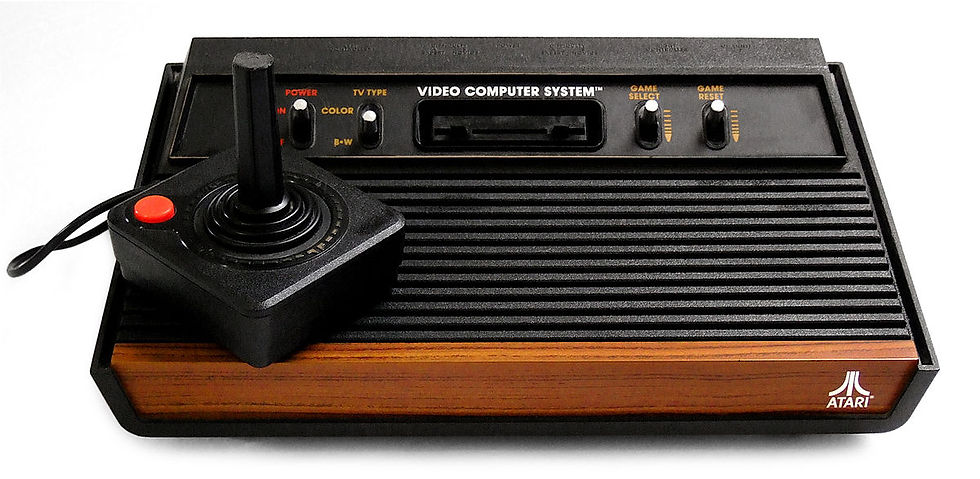
Atari 2600
Other major milestones for home gaming systems over the following twenty-years include the introduction of the Nintendo Entertainment System (NES) to the United States in 1985, leading to the release of Super Mario Bros, Legend of Zelda and Metroid. Games that still have a major influence on modern gaming.
References:
Chikhani, R., 2015. The History Of Gaming: An Evolving Community. [online] Techcrunch.com. Available at: <https://techcrunch.com/2015/10/31/the-history-of-gaming-an-evolving-community/?guccounter=1&guce_referrer=aHR0cHM6Ly93d3cuZ29vZ2xlLmNvbS8&guce_referrer_sig=AQAAADQZPheazplXnDlLPby9o_q-oGNvsIwqZhQ3Tm8sMlmFhkP7kZT7VptdiD2z9PgMH785jagyv74rtP6uKqsSEvkMrPyg3kFGy_UdB5cR04RHB5cbvklVjn4wJyc_iwzv6wf5F3UBQxmGGdqqABusTU1vx-je8WYWXwjT2O5Pw6jp> [Accessed 19 October 2020].
History.com, 2019. Video Game History. [online] History.com. Available at: <https://www.history.com/topics/inventions/history-of-video-games> [Accessed 19 October 2020].
Norman, J., n.d. NIMATRON: An Early Electromechanical Machine To Play The Game Of Nim : History Of Information. [online] Historyofinformation.com. Available at: <https://www.historyofinformation.com/detail.php?entryid=4472> [Accessed 27 October 2020].
Norman, J., n.d. Patent Drawing Of Nimrod. [image] Available at: <https://www.historyofinformation.com/detail.php?entryid=4472> [Accessed 2 November 2020].
Shepherd, C., 2018. A Brief History Of Games Technology. [online] The Reconstructor. Available at: <https://www.reconstructor.org/game/a-brief-history-of-games-technology/> [Accessed 19 October 2020].
Wikipedia, n.d. Atari 2600. [image] Available at: <https://simple.wikipedia.org/wiki/Atari_2600> [Accessed 3 November 2020].


Comments