


Prototyping: Planet Unknown & Me, Myself & Die
Updated: Aug 17, 2020
Moving into the five week prototyping stage of our major projects, it was time for us to determine what core elements and mechanics of our game pitches we needed to demonstrate for our industry pitches.
Planet Unknown
For the Planet Unknown prototype I worked with Dana McKay, Matt Solle, Tristian Duggan, David Flintoft, Angela Stevens, Frances Adams, Sebastian Tuckwell and Brea Fox. When defining what was essential for the Planet Unknown prototype, my group and I broke it down into the following core elements:
Player controller, Traversal & Combat
For the prototype we wanted to demonstrate the players core behaviour, including how they move around and interact with the games environment. This was when we came to the decision that we would use a third party 2D character controller for the player, this was due to it not being force-based, allowing us to have more control over the players movement. The controller we ended up using is from Prime31.
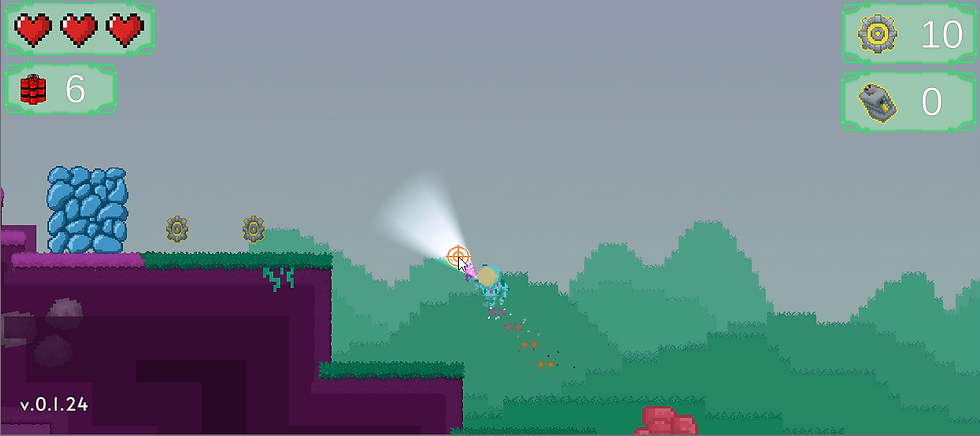
Another player mechanic we wanted to demonstrate was aiming. We wanted the player to have 360 degree aiming and be able to shoot in any direction. This will aid them in combat and solving puzzles in the environment.

2 Power Ups & Puzzles
Power ups and puzzle solving are two other core mechanics of Planet Unknown that go hand-in-hand. We decided to demonstrate two types of power ups and show how they can be used to solve environmental puzzles.
The power up types we demonstrated were the ice gun and explosive bullet. The ice gun allows the player to freeze enemies in blocks of ice, and turns them into walk-able platforms that can aid in traversal. The explosive bullet allows the player to break through destructible blocks and gain access to new areas and cause large amounts of damage to enemies in combat.
2 Enemies
When traversing and exploring Planet Unknown that player can encounter hostile enemies that are different depending on the biome. Because the level we prototyped is set in a jungle biome, our designers concepted two plant based enemies, the vine enemy and the root enemy. See design credits.
The root enemy attacks the player through a wave of roots that spring up from the ground towards the player when they are within range.
The vine enemy is stationary and shoots a vine towards the player in an attempt to grab and pull them towards itself and hazards.
Environment & Art Style
Seeing as a significant aspect of Planet Unknown's experience is the alien and unexplored planet, we wanted to demonstrate what the games would look like in the chosen style. Assets included in the prototypes were the player, enemies, environment tile set, decorations, power ups and player UI. See artist credits.


Planet Unknown Credits:
Design
Dana McKay - General design
Matt Solle - Enemy and mechanics design
Tristian Duggan - Level design
Art
Angela Stevens - Player UI, Enemy sprites and animations.
Frances Adams - Environment tile set and decoration.
Sebastian Tuckwell - Player sprites and animations.
Brea Fox - Power ups.
Programming
David Flintof - Enemy behaviour, power ups, combat
Myself - Player behaviour and player UI
Me, Myself & Die
Me, Myself & Die (MM&D) is a casual mobile game in which you play an alien cube that must solve puzzles in order to escape an Egyptian tomb. To do so, the player must carefully orchestrate their death and use their corpses to navigate through the puzzle.
This was the second group I was apart of for the prototyping stage as one of two programmers. For the MM&D prototype I worked with Jason Marsh, Dean Subritzky, Martin Widdowson, and Cody Lewis.
For the prototype we wanted to demonstrate the following elements:
Player Movement
Movement is grid based and the only controls available to the player. Depending on what quadrant of the screen is tapped, the player will move 1 unit in one of four directions.
The player is able to move to higher platforms using the corpses that spawn after their death.
Death & Corpse Spawning Mechanic
Player death and corpse spawning is a core mechanic of MM&D. The player can die if they move into hazards or fall from a height greater than one block. Upon dying the player is re-spawned at the beginning of the level, with their corpse remaining in the same position their death occurred. Up to three corpses can be present in the level, if a fourth death were to occur the first/oldest corpse will be removed.
These corpses are key to solving each levels puzzle as they would be used to aid in traversing the level and avoid hazards.
Art Style

For the art style we wanted to demonstrate the lighting and simplistic ancient tomb aesthetic using the sandstone detailing and colour palette. See artist credits.
Me, Myself & Die Credits:
Design
Jason Marsh - Level & mechanics design
Dean Subritzky - Monetisation and mechanics design
Art
Martin Widdowson - Lighting, environment, player
Programming
Myself - Input & Player behaviour
Cody Lewis - Player behaviour


Comments